
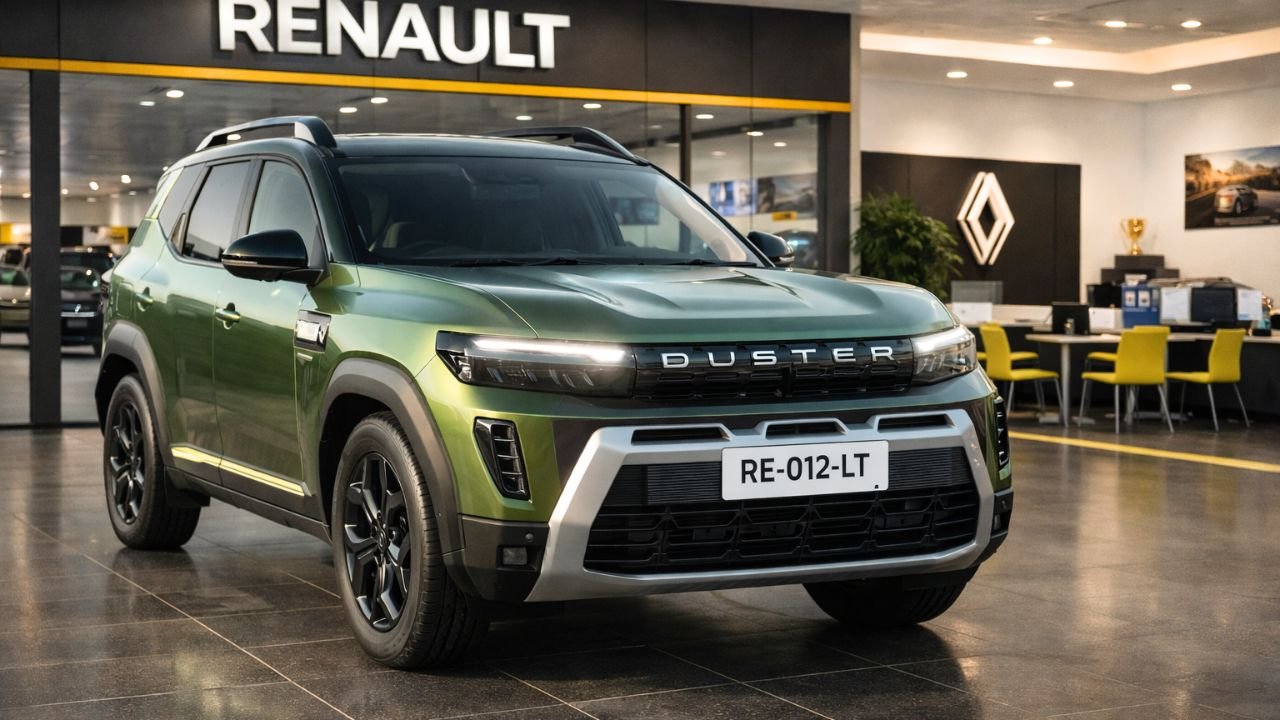
Renault has officially unveiled the third-generation Duster in India on January 26, 2026, marking the brand’s strategic re-entry into one of the country’s most competitive automotive segments after a four-year hiatus. This comprehensive analysis examines the new Duster’s positioning, specifications, competitive landscape, and market potential ahead of its March 2026 price announcement and April 2026 delivery commencement.
The 2026 Duster represents a significant product reset for Renault India, introducing modern design language, premium cabin materials, advanced technology features, and critically—for the first time in the compact SUV segment—a strong-hybrid powertrain alongside conventional turbocharged petrol engines. With pre-bookings already open at ₹21,000 and expected pricing between ₹10-20 lakh (ex-showroom), the Duster targets mass-market appeal while competing directly against established leaders like the Hyundai Creta and emerging strong-hybrid alternatives from Maruti Suzuki and Toyota.
Market Context and Strategic Significance
The original Renault Duster (2012-2022) fundamentally reshaped India’s automotive landscape by pioneering the compact SUV category, a segment that now accounts for the second-highest sales volume among passenger vehicles in the country. The Duster’s discontinuation in 2022 left a vacuum in the rugged, practical SUV space as competitors increasingly focused on premium features and urban refinement. The 2026 return with next-generation architecture and electrified powertrains signals Renault’s commitment to reclaim market share in a segment now dominated by the Hyundai Creta and characterised by intense price-based competition.
The competitive intensity has escalated dramatically since the original Duster’s era. Today, the mid-size SUV space encompasses approximately ten major players, including the Creta, Kia Seltos, Tata Sierra, Maruti Suzuki Grand Vitara and Victoris, Toyota Hyryder, Honda Elevate, Volkswagen Taigun, Skoda Kushaq, and MG Astor. This fragmentation creates both opportunity and risk: buyers enjoy unprecedented choice, but market share gains require either substantial competitive advantage or aggressive pricing.
Product Architecture and Design Philosophy
Platform and Engineering Foundation
The 2026 Duster leverages the CMF-B (Common Modular Family) platform, a shared architecture developed across the Renault-Nissan-Mitsubishi Alliance. Approximately 90 per cent of the vehicle’s components were developed specifically for the Indian market, ensuring localisation in manufacturing cost, service accessibility, and regional feature requirements. The CMF-B platform was explicitly engineered to accommodate both conventional and electrified powertrains, providing technical flexibility absent in legacy competitors.
Exterior Design Language
The new Duster adopts an overtly rugged aesthetic that differentiates it from the premium-focused, design-forward approach of competitors like the Creta. Key visual elements include rectangular LED headlamps with characteristic eyebrow-shaped LED daytime running lights, a wide grille with prominent Duster badging, and pixel-patterned fog lamps flanking an aggressive front bumper with integrated skid plate protection.
The body features extensive black plastic cladding around wheel arches and lower sections—a stylistic choice signalling off-road capability rather than urban polish. Rear door handles are positioned on the C-pillar (a practical design reducing door complexity), while an integrated LED light bar spans the rear tailgate, a feature absent on the global model and specifically requested for Indian preferences. The functional roof rails carry a 50-kilogram load rating, supporting practical cargo applications.
This design direction intentionally repositions the Duster away from Creta’s premium, smooth surfaces and toward a more utilitarian, adventure-oriented identity. Industry observers note this represents a calculated market segmentation strategy: the Duster targets buyers prioritising capability and practicality for mixed-road conditions, while competitors focus on urban refinement and luxury perception.
Interior Execution and Material Quality
The cabin represents a meaningful material upgrade versus the outgoing generation, with leatherette trim applied across seats, dashboard, and door panels in a black-with-green-accents colour scheme. The dashboard employs a Y-shaped design language echoed in the AC vents and steering wheel, creating visual coherence absent in many segment competitors. Carbon-fibre-style inserts on the dashboard and doors add texture without high cost.
The dual-screen setup comprises a 10.1-inch infotainment touchscreen (supporting wireless Android Auto and Apple CarPlay) paired with a 10.25-inch digital instrument cluster, or alternatively, a 7-10 inch Google OS-integrated display on some variants. While this dual-screen configuration trails the full-width integrated displays offered on premium-positioned competitors, it delivers modern connectivity at accessible price points.
Practical features, including PM 2.5 air filtration, dual-zone automatic climate control, wireless phone charging, and type-C USB charging, reflect an understanding of Indian buyer preferences for air quality management and device connectivity. The electric tailgate, 6-way powered front seats with ventilation, and 60:40 split rear seatbacks address comfort and convenience expectations at this price point.
Renault Duster 2026 Engine Options and Specifications
| Engine | Displacement | Power | Torque | Transmission | Type |
|---|---|---|---|---|---|
| 1.0L Turbo Petrol (TCe 100) | 999 cc | 99-100 bhp | 160 Nm | 6-speed Manual | 3-Cyl Turbo |
| 1.3L Turbo Petrol (TCe 160) | 1,289 cc | 160-163 bhp | 280 Nm | 6-spd Manual / DCT | 4-Cyl Turbo |
| 1.8L Strong Hybrid E-Tech 160 | 1,789 cc | 160 bhp (system) | 172 Nm | 8-speed DHT | 4-Cyl NA + 2 Motors |
Powertrain Strategy: Three-Engine Coverage Model
The Duster’s powertrain lineup reflects a sophisticated market segmentation strategy, offering three distinct propulsion systems to capture buyers across value, performance, and efficiency preferences while notably eliminating diesel—a strategic bet on regulatory trends and manufacturing economics.
Entry-Level Efficiency: 1.0L Turbocharged Petrol (TCe 100)
The 1.0-litre three-cylinder turbocharged petrol engine produces 99-100 bhp and 160 Nm of torque, paired exclusively with a 6-speed manual transmission. This powerplant—identical to the unit deployed in the Nissan Magnite—establishes an aggressive price floor while delivering adequate performance for budget-conscious buyers willing to tolerate manual transmission operation. The 99 bhp output positions this variant primarily for urban and suburban use rather than highway or off-road exploration.
At this power level, real-world acceleration (0-100 km/h likely exceeding 12 seconds) and highway cruising dynamics will feel modest by contemporary standards, though fuel efficiency metrics should prove competitive—potentially 15-18 km/L depending on driving patterns and traffic conditions.
Segment-Leading Performance: 1.3L Turbocharged Petrol (TCe 160)
The flagship turbocharged petrol engine deserves particular analytical attention, as it represents Renault’s primary competitive weapon against the Creta’s 163 bhp turbo variant and other 1.5L turbocharged competitors. The 1.3-litre four-cylinder turbo generates 160-163 bhp and critically, 280 Nm of torque—a specification that exceeds competing 1.5L naturally aspirated engines and matches or exceeds most turbo competitors in the segment.
This 280 Nm torque figure represents the tangible competitive advantage. In real-world driving, particularly on Indian highways with variable road conditions, torque availability matters more than peak horsepower for drivability and safety (enabling swift overtaking and hill-climbing). Renault’s positioning of the TCe 160 as the segment’s most powerful turbo-petrol engine carries valid merit and likely constitutes the primary reason to select the Duster over competitors seeking performance without waiting for the hybrid variant.
Transmission options include a 6-speed manual or 6-speed dual-clutch automatic (DCT) with wet-clutch technology, addressing both cost-conscious and automatic-preferring buyers. The DCT selection proves particularly important, as segment competitors increasingly standardise on continuously variable transmissions (CVT), which deliver smoother power delivery at the cost of sportier feel and efficiency gains. Renault’s traditional torque-converter-based automatic on non-hybrid variants may appeal to buyers prioritising familiar driving characteristics and conventional service familiarity.
Future-Forward Efficiency: 1.8L Strong-Hybrid E-Tech 160
The strong-hybrid variant represents Renault’s technological differentiation and aligns with India’s shift toward electrification without the range-anxiety concerns of battery electric vehicles. Launching before Diwali 2026 (approximately November 2026), this powertrain combines a 1.8-litre naturally aspirated four-cylinder engine with dual electric motors delivering 160 bhp and 172 Nm of combined system output.
Technical Architecture: The hybrid system employs an 8-speed Dual-Hybrid Transmission (DHT) rather than the continuously variable transmission (e-CVT) used by competitors like the Maruti Grand Vitara and Toyota Hyryder. The DHT operates by selecting between pure electric propulsion (at low speeds), combustion engine operation, or combined hybrid mode depending on driving conditions—functioning mechanically more akin to a conventional automatic than an e-CVT’s infinitely variable ratio system.
Battery and EV Capability: The 1.4 kWh battery pack (approximately double the capacity of Toyota’s hybrid system) enables Renault’s claim that up to 80 per cent of city-cycle driving can occur in pure electric mode. This specification carries significance for stop-and-go urban commuting, where regenerative braking and low-speed electric propulsion deliver meaningful efficiency gains. Renault has not yet disclosed official fuel consumption figures for the hybrid variant, a notable omission that prevents comparative efficiency analysis against the Hyryder (estimated 23-24 km/L) and Grand Vitara (estimated 22-23 km/L).
Market Positioning: By introducing the hybrid variant after initial petrol-variant deliveries, Renault employs a staged rollout strategy, maximising early cash flow from turbo-petrol sales while deferring the capital expenditure and supply-chain complexity of hybrid variant production. This phased approach also allows Renault to observe customer response to the base Duster before committing to hybrid scale, reducing inventory risk.
The hybrid option fundamentally alters competitive dynamics by offering efficient operation without diesel’s emissions complexity or battery electric’s charging infrastructure dependency—a positioning that directly threatens the Hyryder and Grand Vitara’s unique selling propositions in the efficiency-conscious buyer segment.
Physical Specifications and Practical Positioning
The Duster’s dimensional characteristics and functional capacity establish its competitive positioning more clearly than styling or infotainment alone.
Renault Duster 2026 vs Key Mid-Size SUV Competitors – Core Specifications
| Vehicle | Ground Clearance (mm) | Boot Space (L) | Length (mm) | Est. Price |
|---|---|---|---|---|
| Renault Duster 2026 | 212 | 700 | 4,343 | ₹10-20 L |
| Hyundai Creta | 200 | 433 | 4,330 | ₹11-18 L |
| Kia Seltos | 200 | 440 | 4,315 | ₹11-19 L |
| Tata Sierra | 205 | 530 | 4,400 | ₹12-20 L |
The ground clearance advantage (212 mm) places the Duster second only to the Honda Elevate (220 mm) in the segment, providing measurable benefits for speed-breaker clearance, water-ford capability, and rough terrain navigation. The 700-litre boot capacity claims an 80-litre advantage over the nearest competitor, translating to tangible practicality for families requiring larger cargo capacity—a fundamental requirement in Indian usage patterns where vehicles often serve dual passenger-cargo roles.
The approach (26.9°) and departure (34.7°) angles quantify off-road geometry that competitors largely ignore in specification sheets, signalling the Duster’s positioning as genuinely capable for unpaved surfaces rather than merely styled as rugged. This technical specification differentiates the Duster from urban-optimised competitors and appeals to buyers in tier-2/tier-3 cities where road infrastructure remains inconsistent.
Safety and Advanced Driver Assistance
The 2026 Duster achieves the distinction of being the first Renault vehicle in India to incorporate a comprehensive Advanced Driver Assistance Systems (ADAS) suite, marking a significant advancement in safety technology adoption at this price point.
The standard six airbag configuration (driver, passenger, side, and curtain units) provides fundamental impact protection. The 360-degree parking camera system, front and rear parking sensors, and tyre pressure monitoring system (TPMS) address everyday convenience and safety awareness. However, the Level 2 ADAS implementation deserves closer examination.
Renault specifies 17 ADAS features without detailed elaboration on each function, which is common industry practice pending official launch documentation. Expected capabilities likely include adaptive cruise control, lane-keep assist, lane-departure warning, forward-collision alert, and automatic emergency braking—features increasingly expected at this price point. The electronic parking brake with auto-hold, coupled with all-disc braking, addresses modern parking and hill-start expectations.
Renault’s claim that the Duster is “ready to achieve 5-star safety ratings” (presumably referencing the Bharat New Car Assessment Programme or NHTSA-equivalent testing) remains unverified and should be interpreted cautiously until official crash test results are disclosed. Competing vehicles like the Hyundai Creta similarly carry uncertified safety aspirations until third-party validation occurs.
Market Positioning and Competitive Dynamics
Target Customer Profile
Analysis of the Duster’s specifications reveals a deliberately differentiated target buyer segment:
Primary Target: The Duster appeals to buyers aged 30-45 with young families, a preference for practical usability over premium perception, mixed driving patterns (urban commuting plus occasional intercity or rough terrain), and willingness to prioritise capability and cargo space over cosmetic refinement. These buyers often represent first-time mid-size SUV purchasers or individuals upgrading from compact vehicles (Baleno, Creta variant downgrades, older Duster owners).
Geographic Focus: With 212 mm ground clearance and specified off-road geometry, the Duster targets high-volume opportunity in tier-2 and tier-3 cities (Indore, Nagpur, Jaipur, Bhopal, Lucknow) where road infrastructure varies significantly and practical capability matters more than premium aesthetics. This geographic positioning aligns with Renault’s broader strategy of achieving scale through value-oriented regional markets rather than tier-1 metro concentration.
Value Consciousness: The expected ₹10-20 lakh pricing spans the broad value-conscious to aspiring-premium buyer segment. The entrance-level ₹10 lakh pricing (especially for the 1.0L TCe 100 variant) positions the Duster competitively below the Creta’s ₹11 lakh floor, potentially capturing first-time mid-size SUV buyers currently deciding between the Kiger (compact) and Creta (mid-size) categories.
Competitive Advantages
1. Segment-Leading Torque Output: The 163 bhp/280 Nm 1.3L turbo significantly outmatches the Creta’s 163 bhp/253 Nm 1.5L turbo, with practical implications for highway acceleration and load-hauling capability. This specification advantage, combined with aggressive positioning as “most powerful turbo-petrol in segment,” constitutes Renault’s primary performance-based competitive weapon.
2. Superior Practical Capacity: The 212 mm ground clearance and 700L boot space address fundamental buyer needs that transcend aspiration value. Families requiring genuine cargo capacity for vacation travel, construction material transport, or agricultural implements will find the Duster’s specifications quantifiably superior to the Creta’s engineering priorities.
3. Hybrid Option Availability: By offering strong-hybrid technology alongside turbo-petrol engines, the Duster positions itself across both efficiency and performance segments simultaneously. The delayed (Diwali 2026) hybrid availability could prove strategic, allowing Renault to gauge market interest in turbo variants before scaling hybrid production.
4. Cost-Competitive Service Network: Renault operates 187 authorised service centres across 157 Indian cities, providing geographic coverage comparable to or exceeding competitors like Kia, while potentially offering lower service costs than premium brands.
Competitive Vulnerabilities
1. Brand Perception and Market Absence: Renault’s four-year market absence (2022-2026) creates significant reputational risk. Buyers have developed strong loyalty to the Creta (market leader), and the Duster will require a compelling value proposition or emotional resonance to displace established preferences. The original Duster’s discontinuation, rather than successful evolution, may signal weakness to some market segments.
2. Infotainment and Technology Perception: While the dual-screen setup (10.1″ + 10.25″) delivers modern connectivity, competitors increasingly standardise on larger, integrated displays (Creta’s dual 12.3″ screens). This perception gap, though narrowing, may disadvantage the Duster in showroom comparisons, particularly among younger, technology-conscious buyers.
3. Interior Premium Perception: The Creta’s softer, more extensively cushioned cabin materials and ambient lighting create a perceived premium environment that the Duster’s leatherette-and-plastic combination may struggle to match psychologically, despite superior functional practicality. This perception gap particularly affects buyers viewing the SUV as an aspirational lifestyle purchase rather than a utilitarian tool.
4. Uncertain Hybrid Fuel Efficiency: Without disclosed fuel consumption figures for the E-Tech hybrid variant, the Duster cannot substantiate efficiency claims against proven competitors (Hyryder’s 23-24 km/L, Grand Vitara’s 22-23 km/L). Official disclosure at launch will be critical for competitive positioning.
Launch Timeline and Commercial Availability
Renault has structured the Duster launch across a deliberate three-phase timeline, maximising early market momentum while managing production and supply-chain complexity.
Phase 1: Pre-Booking (January 26 – March 15, 2026): Pre-bookings commenced immediately upon unveiling at ₹21,000, with Renault offering priority delivery, special introductory pricing, and exclusive merchandise to early commitments. This phase establishes demand signals while securing working capital, with expected booking volumes of 5,000-10,000 units (industry estimates based on competitive launches).
Phase 2: Turbo-Petrol Deliveries (April 2026 onwards): The 1.0L TCe 100 and 1.3L TCe 160 variants commence customer deliveries in April 2026, allowing Renault to achieve initial sales volume and revenue while hybrid variant production scales. This phased approach reduces capital expenditure concentration and manages inventory risk. Analysts expect monthly sales volumes to ramp from 2,000-3,000 units (April-June) to 4,000-6,000 units (post-stabilisation) for the petrol variants.
Phase 3: Strong-Hybrid Launch (Diwali 2026): The 1.8L E-Tech strong-hybrid variant launches approximately November 2026, expanding the addressable market to efficiency-conscious buyers and capturing market share from the Hyryder and Grand Vitara. The delayed availability aligns with inventory management, as hybrid components (electric motors, battery packs) often face supply constraints relative to conventional petrol engines.
Pricing Strategy and Expected Market Reception
Renault has not yet disclosed official pricing (announcement scheduled for March 2026), but industry consensus and pre-launch estimations suggest the following bracket:
| Variant | Estimated Ex-Showroom | On-Road (Delhi) |
|---|---|---|
| 1.0L TCe 100 Manual | ₹10.0-10.5 lakh | ₹11.2-11.8 lakh |
| 1.3L TCe 160 Manual | ₹11.5-12.5 lakh | ₹13.0-14.0 lakh |
| 1.3L TCe 160 DCT | ₹13.0-14.0 lakh | ₹14.5-15.5 lakh |
| 1.8L E-Tech Hybrid | ₹14.5-16.5 lakh | ₹16.5-18.5 lakh |
This pricing strategy positions the Duster’s entry point (₹10 lakh) below the Creta’s floor, capturing budget-conscious buyers, while the TCe 160 DCT and future hybrid variants compete at mid-to-premium price points. The pricing structure reflects Renault’s volume-focused strategy, prioritising market share gains over margin maximisation in the critical early phases.
Financial Viability and Manufacturing Economics
The Duster’s reliance on the CMF-B platform—shared across Renault, Nissan, and Dacia models globally—provides substantial cost advantages. Component commonality, shared supply chains, and amortized R&D costs across multiple OEM partners reduce per-unit manufacturing cost, enabling aggressive ex-showroom pricing while maintaining acceptable gross margins (likely 18-22% on the base 1.0L variant, tapering to 12-15% on the hybrid).
However, Indian market realities constrain margin expansion: intense price competition, high working-capital requirements for dealer inventory, and warranty/service obligations create structural pressure on profitability. Renault’s strategy appears to prioritise market reentry and volume achievement over premium margins, expecting profitable scale to emerge in years 2-3 as production stabilises and brand equity strengthens.
Risk Factors and Downside Scenarios
Demand Risk: If market uptake proves significantly below pre-booking levels (fewer than 40,000 units annually), Renault may be forced to further discount pricing, compress margins, or reduce production—potentially forcing facility closures and workforce reduction. The compact SUV segment’s growth rate has moderated significantly since 2020-2022, suggesting saturation risk.
Competitive Response: Hyundai, facing genuine competitive pressure from the Duster’s superior torque and lower entry pricing, may respond with aggressive incentives, financing schemes, or mid-cycle Creta updates. This competitive escalation would compress margins across the segment, harming Renault’s profitability timeline.
Hybrid Supply Constraints: Global semiconductor and electric motor supply chains remain volatile. If hybrid component sourcing delays the Diwali 2026 launch beyond Q4, Renault risks ceding momentum to competitors and disappointing early customers awaiting efficiency options.
Regulatory Uncertainty: India’s automotive regulatory environment remains subject to rapid change. Potential shifts in emissions standards (CAFE mandates), safety requirements (mandatory autonomous emergency braking), or electrification subsidies could affect the Duster’s competitive positioning and manufacturing cost structure.
Strategic Conclusion
The 2026 Renault Duster represents a calculated, competitively credible re-entry into India’s mid-size SUV segment, backed by modern platform architecture, pragmatic design prioritising capability over aspirational appeal, and a three-powertrain strategy spanning value, performance, and efficiency segments. The Duster’s physical specifications (212 mm ground clearance, 700L boot) and mechanical advantages (280 Nm torque) establish tangible competitive differentiation in the practical utility dimension—a positioning that directly challenges competitors’ focus on premium interiors and urban refinement.
Success hinges on four critical factors: (1) aggressive but sustainable pricing achieving the ₹10 lakh entry point, (2) flawless hybrid powertrain execution and timely Diwali 2026 launch, (3) dealer network activation and service quality perception management, and (4) compelling brand messaging repositioning the Duster not as a discontinued model’s successor but as a forward-looking vehicle category leader. Market share targets of 8-12% in the compact SUV segment (approximately 80,000-120,000 annual units by year 3) appear achievable if execution matches strategic ambition.
The Renault Duster’s return promises to reinvigorate competition in a segment where consolidation around the Creta had begun settling into a leadership pattern. Buyers will benefit from renewed innovation, aggressive pricing, and renewed emphasis on practical capability—fundamentals that defined the original Duster’s pioneering role in India’s automotive landscape.
Must Read: 2026 Kia Seltos Price Starts ₹10.99 Lakh – Full Variant List & EMI
Reference Links:
1 thought on “The 2026 Renault Duster: India’s Long-Awaited SUV Comeback”