
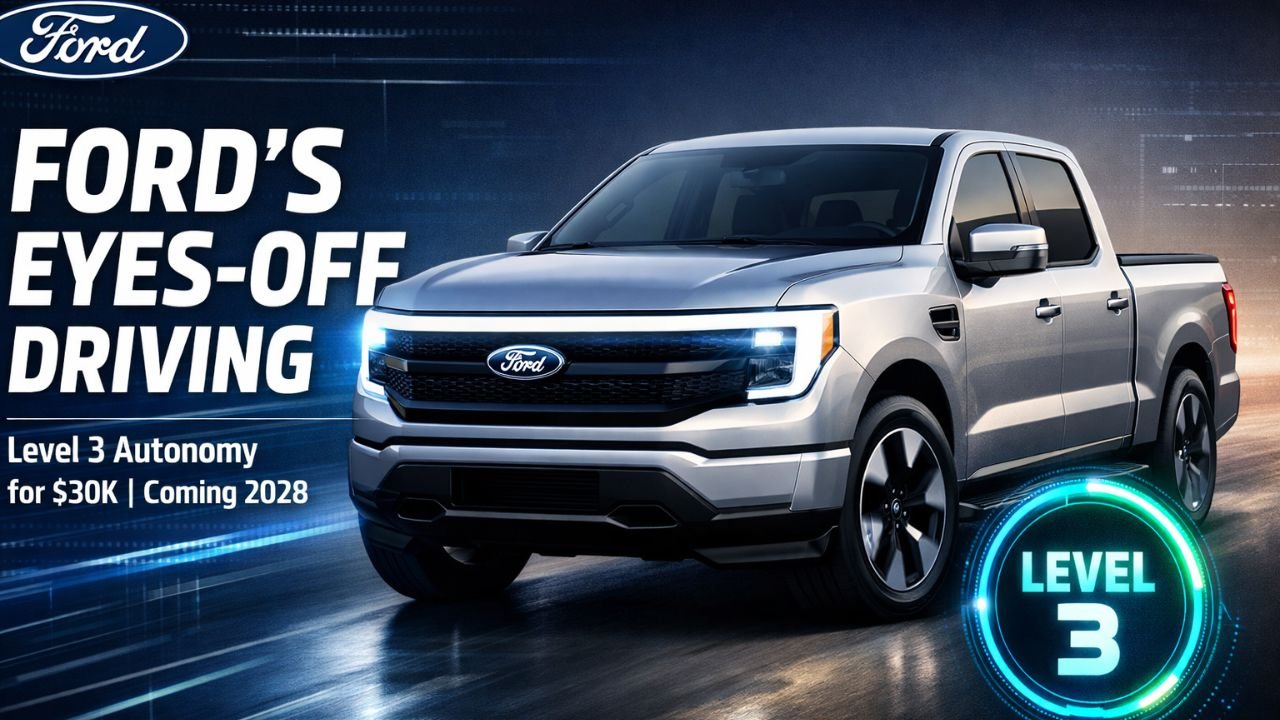
Ford is developing a new EV on a low-cost “Universal EV Platform” that is expected to start at about USD 30,000 and later support Level 3 “eyes‑off” autonomous driving on highways. This ambitious move represents a watershed moment in the automotive industry, where advanced autonomous driving capabilities—once exclusive to premium luxury vehicles—are finally becoming accessible to ordinary drivers and everyday car buyers.
A Game-Changer for Affordable EVs
For the first time in automotive history, advanced hands-free driving technology is heading to mass-market vehicles instead of staying locked in luxury showrooms. Ford plans to debut Level 3, eyes‑off driver assistance in 2028 on an upcoming midsize electric pickup built on its new Universal EV platform. The first vehicle on this platform is targeted to launch in 2027 at around USD 30,000, with the Level 3 capability arriving about a year later via new hardware and software upgrades.
This timeline is significant because it demonstrates Ford’s confidence in both the technology’s maturity and the regulatory landscape’s evolution. The company isn’t just talking about autonomous driving—it’s committing to a specific vehicle, a specific price point, and a specific date. That kind of transparency is rare in the automotive industry, where automakers often overpromise on autonomous capabilities and underdeliver on timelines.
The Universal EV Platform itself is a crucial component of Ford’s strategy. By developing a modular platform designed from the ground up for electrification and autonomous driving integration, Ford is creating an architecture that can support multiple vehicle types without requiring expensive re-engineering for each model. This approach helps keep costs down, which is essential for hitting that USD 30,000 target while still incorporating sophisticated autonomous systems.
Understanding Level 3 Autonomy: What “Eyes-Off” Really Means
Here’s where the technology gets genuinely interesting, and it’s important to understand exactly what Ford is promising. Level 3 autonomy means the car can handle driving in specific, predetermined conditions—primarily mapped highways—without the driver keeping their eyes on the road. This is fundamentally different from the hands-free systems currently available in many vehicles today.
To clarify the distinction: Ford’s current BlueCruise Level 2 system, which already functions on over 130,000 miles of divided highways, allows drivers to remove their hands from the wheel, but it still requires constant driver attention. The driver must be watching the road, ready to intervene at any moment. It’s essentially glorified cruise control with lane-keeping assistance, no matter how sophisticated the marketing materials might suggest.
Level 3, by contrast, allows the driver to genuinely disengage from the driving task. You could theoretically watch a movie, read a book, or simply relax while the car handles highway navigation. The system monitors the road, manages lane changes, adapts to traffic conditions, and maintains safe speeds—all without human intervention.
However—and this is crucial—the driver must still be prepared to take control if the system encounters a situation it cannot handle or if it requests a “handover.” If the vehicle reaches the end of a mapped highway, exits the freeway, or encounters severe weather or road conditions beyond its programming, it will alert the driver to resume manual control. The driver then typically has a grace period (often a few seconds to a minute, depending on the system) to respond before the vehicle takes a safe action like gradually reducing speed and moving to the shoulder.
This distinction between Level 2 and Level 3 might seem technical, but it represents a massive leap in functionality and driver experience. Level 3 systems are already operating in some markets—notably Mercedes-Benz with its Drive Pilot system in Germany and Japan—but they’ve remained limited to premium vehicles selling for six figures.
The Technology Behind Eyes-Off Driving
Making a Level 3 system work requires an intricate stack of technologies working in harmony. The vehicle needs multiple cameras, lidar sensors, radar systems, and high-precision GPS to understand its surroundings and navigate with confidence. The processing power must be substantial enough to make real-time decisions based on constantly updating road conditions, traffic patterns, and potential obstacles.
Ford’s approach leverages years of development through its BlueCruise program and partnerships with technology companies. The company has been collecting real-world driving data for years, testing systems on actual highways, and refining algorithms based on millions of miles of autonomous and assisted driving. This data-driven approach is critical because autonomous systems only get better with more real-world examples to learn from.
Additionally, Level 3 systems require a robust cybersecurity architecture. A vehicle that can drive itself is, by definition, a vehicle that could theoretically be hacked. Ford will need to ensure that its autonomous systems are protected against both malicious attacks and unintended software glitches. This adds layers of redundancy, encryption, and continuous monitoring to the system architecture.
Breaking the Luxury Barrier: Why This Matters
The market context makes Ford’s announcement particularly noteworthy. Today, systems approaching Level 3 capability are almost exclusively found on high‑end vehicles such as the Cadillac Escalade IQ (starting at USD 100,000+) or premium German models from Mercedes-Benz and BMW, which also command six-figure price tags. The technology has been treated as a premium feature, something that justifies charging wealthy buyers significantly more for their vehicles.
Ford’s strategy explicitly rejects this luxury-segmentation approach. By putting Level 3 on a roughly USD 30,000 EV pickup, the company is making a bold statement: advanced driver‑assist technology shouldn’t be reserved for wealthy buyers living in affluent neighbourhoods. A person buying an affordable electric truck should have access to the same technological conveniences that a luxury car buyer enjoys.
This democratisation of autonomous technology has several implications. First, it puts pressure on other automakers to follow suit. If Ford delivers a competitive Level 3 system at USD 30,000, competitors like General Motors, Tesla, Volkswagen, and others will face intense pressure to match that capability and price point. This competitive dynamic accelerates industry-wide adoption of autonomous features.
Second, it signals to consumers that the autonomous driving future is arriving faster than many people expected. Just a few years ago, Level 3 autonomy seemed like a distant dream, something that might happen in the 2030s or beyond. Ford’s 2028 timeline suggests we’re closer than that—and if Ford hits its targets, other manufacturers will likely follow within the next few years.
Third, it creates opportunities for innovation in the EV market. Autonomous driving capability is a genuine differentiator. While all electric vehicles ultimately use similar battery and motor technologies, the software and autonomous features can vary dramatically. This shift toward autonomous capabilities at all price points could help electric vehicles gain broader consumer acceptance by offering tangible benefits beyond environmental considerations.
The Regulatory and Safety Landscape
One reason Ford can make such confident announcements is that the regulatory environment for Level 3 autonomy is clarifying. In the United States, the National Highway Traffic Safety Administration (NHTSA) has been developing frameworks for autonomous vehicle certification and operation. Several states have already passed legislation permitting Level 3 systems on public roads.
This regulatory clarity is essential. Without it, automakers face uncertainty about whether they’ll actually be able to deploy the systems they develop. Mercedes-Benz had to wait years for German and Japanese regulatory approval before launching its Drive Pilot system, even though the technology was ready much earlier.
Ford’s 2028 timeline appears to be built on the assumption that regulatory frameworks will be in place by then—either federally in the United States or through a patchwork of state regulations. This timing also allows the company to observe and learn from early adopters of Level 3 technology in other markets, refining its own systems based on real-world performance data and user feedback.
Consumer Expectations and Adoption Challenges
While the technology is impressive and the price point is compelling, Ford faces significant challenges in consumer adoption and acceptance. Many drivers, when given the option to take their eyes off the road and hands off the wheel, will initially feel uncomfortable. Trust in autonomous systems doesn’t come automatically—it must be earned through consistent, reliable performance and transparent communication about system limitations.
Ford will need to invest heavily in driver education and marketing to help consumers understand what Level 3 can and cannot do. There will likely be a learning curve, and some early adopters will experience situations where the system performs unexpectedly or requests a handover at an inconvenient moment. How Ford communicates about these experiences and how drivers respond will significantly influence broader adoption rates.
Additionally, insurance and liability questions remain somewhat unsettled. When a Level 3 autonomous vehicle is driving without human input, and something goes wrong, who bears responsibility? The driver? The manufacturer? The insurance company? These legal and insurance frameworks are still being worked out, and clarity here could either accelerate or impede adoption.
What This Means for the Future of Driving
Ford’s announcement represents a pivotal moment in automotive history. For decades, the industry has been moving incrementally toward autonomous driving—adding cruise control, then adaptive cruise control, then lane-keeping assistance, and so on. Level 3 represents the first time that drivers can genuinely step back from the driving task in normal, everyday conditions.
If Ford executes successfully, we’re looking at a future where highway driving becomes fundamentally different within the next two to three years. Morning commutes could become more relaxing. Long road trips could be significantly less fatiguing. The value proposition of electric vehicles—which already offer lower operating costs due to cheaper electricity versus gasoline—becomes even more compelling with autonomous driving capability included.
Moreover, this technology could have broader safety implications. Human error accounts for the vast majority of traffic accidents. If Level 3 and higher autonomous systems prove to be safer than human drivers (which preliminary data suggests they are), then widespread adoption of these technologies could save thousands of lives annually.
Conclusion
Ford’s commitment to bringing Level 3 autonomous driving to a USD 30,000 vehicle by 2028 is far more than just a product announcement. It’s a statement about the future of mobility, a commitment to technological democratisation, and a competitive gauntlet thrown down to the rest of the automotive industry. If the company delivers on this promise, it will fundamentally reshape how we think about driving, vehicle ownership, and the role of technology in our daily lives. The eyes‑off future isn’t just coming—it’s arriving faster than most people realise.
Must Read: Maruti Victoris 2026 Honest Review: Is It Really Worth ₹10.50-19.99 Lakhs?
Reference Links: