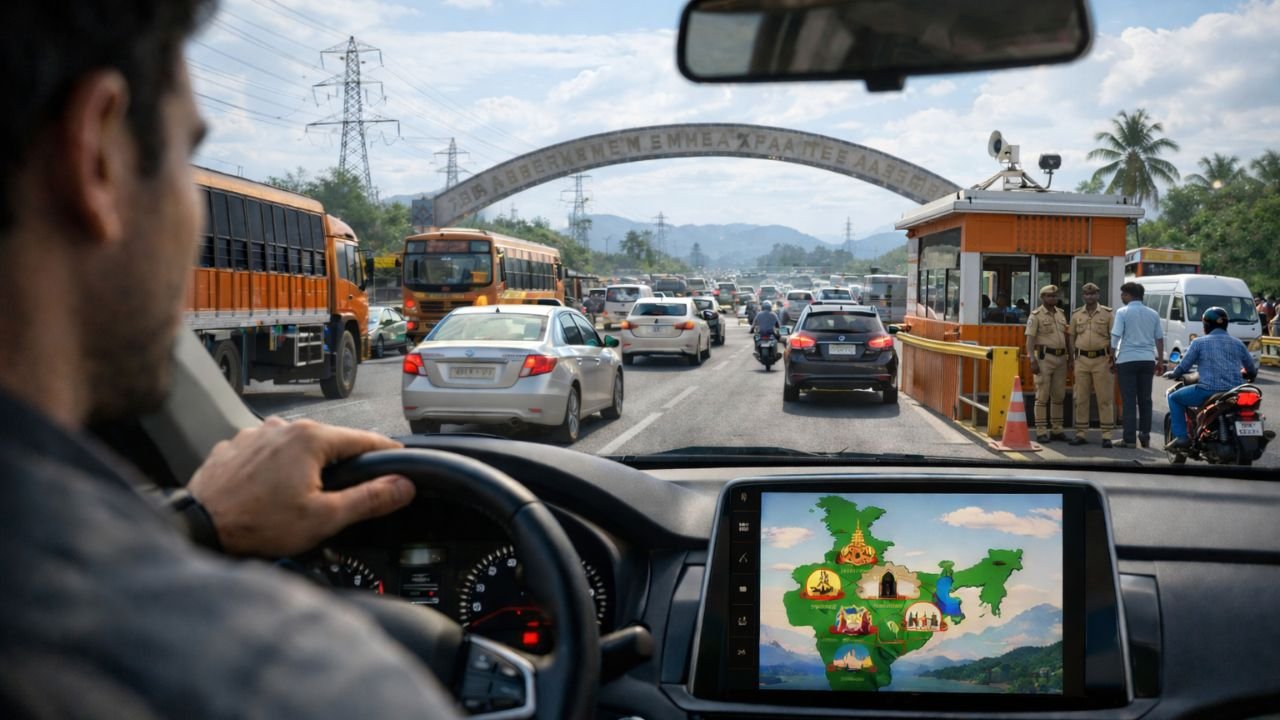
If you think one driving licence lets you drive the same way everywhere in India, think again – traffic rules and, more importantly, penalties can change as soon as you cross a state border. India loses over 1.5 lakh lives in road accidents every year, so states are constantly tweaking fines, speed limits, and enforcement to push drivers towards safer behaviour.
One country, one Act – but many state rules
India’s traffic system runs primarily under the Motor Vehicles Act, a central law passed by Parliament that regulates licensing, registration, basic offences and penalties across the country. The Act lays down standard offences like overspeeding, drunk driving, driving without a licence, or violating pollution norms, and prescribes a base range of punishments for each.
However, states are allowed to frame their own rules, notifications and fine amounts within the broad framework of the Act, especially after the 2019 amendments that sharply increased maximum penalties. This is why two drivers committing the same violation in two different states can end up paying very different challan amounts even though the underlying law is the same.
Why do traffic rules differ between states?
States and Union Territories have differing road networks, traffic density, accident patterns and political priorities, so they don’t copy-paste each other’s traffic policies. Some governments take a strict, high-fine approach to boost deterrence, while others keep fines relatively lower but run awareness campaigns more aggressively. Urbanised states with major metros often tighten rules around seat belts, lane discipline and red-light jumping compared to largely rural states where enforcement capacity is lower.
Enforcement technology also varies: some states rely heavily on AI cameras and e-challans, while others still depend more on on-the-spot checks by traffic police. As these systems expand, state governments continue adjusting fine amounts and compounding options to match local political and economic realities.
Where states differ most
Fines and challans
The biggest visible difference is in the amount you pay when caught. A single comparison across Delhi, Uttar Pradesh, Maharashtra and Tamil Nadu shows how far numbers can diverge. For example, a no-seat-belt violation costs ₹1,000 in Delhi, UP and Tamil Nadu, but only ₹200 in Maharashtra, according to a 2025 fines list compiled from state challan schedules.
For some documentation and signal-related offences, the gap becomes even clearer, as shown below.
Sample fine differences (2025)
Other comparisons tell the same story: one overview notes that fine amounts for jumping a red light can be as low as ₹200 in some states, like Maharashtra and as high as ₹1,000 in Delhi. Similar state-to-state differences appear across overspeeding, signal jumping, wrong-side driving and obstructive parking.
Helmet and seat belt enforcement
At the national level, rules are clear: both rider and pillion on two-wheelers must wear BIS/ISI compliant helmets, and drivers plus front passengers in four-wheelers must wear seat belts. Recent “Road Safety Rules 2025” reforms further stress ISI-certified helmets and ban the sale and use of non-ISI helmets, with fines and even seizure for non-compliance.
For cars, central rules require manufacturers to provide seat belts for the driver and front passengers, and violations of seat belt rules fall under Section 177 of the Motor Vehicles Act, which allows a general fine for contravening the Act or rules. While this legal foundation is uniform, states and cities differ in how intensely they run special drives for rear-seat belts, pillion helmets, or child restraints, which is why enforcement can feel much stricter in some urban pockets than others.
Speed limits
On paper, India now follows a more structured, tiered speed-limit system that distinguishes between urban roads, national highways through cities and high-speed expressways. Under the 2025 safety rules, typical maximums include 50 km/h for cars on city roads, 70 km/h on national highways passing through cities and 100–120 km/h on open highways and expressways, depending on lane and signage.
Travel advisories and road-safety guides also note that many cities keep general limits around 50–60 km/h in urban areas, 80–100 km/h on highways and drop to roughly 25–30 km/h in school zones. However, each state traffic department and city corporation has the power to notify its own speed limits for specific corridors, and national advisories explicitly warn that actual limits may vary and must always be checked on local signboards and official portals.
Drunk driving: same offence, different outcomes
Legally, the permissible blood alcohol concentration is 0.03% in India, meaning more than 30 mg of alcohol per 100 ml of blood counts as drunk driving. The Motor Vehicles Act prescribes fines and possible imprisonment for exceeding this limit, and the 2019 amendments increased the maximum punishment to make the offence more serious nationwide.
In practice, however, states handle challans differently. In many big states like Uttar Pradesh, Maharashtra and Tamil Nadu, driving under the influence attracts a straight fine of around ₹10,000 and/or imprisonment up to 6 months for a first offence, as reflected in their published challan schedules. In Delhi, on the other hand, cases are often sent directly to court, and the actual fine amount is left to the court’s discretion, which can result in higher or lower penalties depending on circumstances.
A state-wise comparison of Madhya Pradesh and Uttar Pradesh shows yet another approach: MP imposes a ₹10,000 fine plus up to six months’ jail for the first drunk-driving offence, with subsequent offences rising to ₹15,000 and up to two years’ imprisonment, while UP sticks closer to the central fine and jail range. These variations illustrate how states can be tougher or more lenient even under the same central legal framework.
Pollution and PUC challans
Pollution control is another area where states have gone in different directions. Central rules require vehicles to carry a valid Pollution Under Control Certificate (PUCC), and the Motor Vehicles Act provides for penalties when this is ignored. But actual challan amounts are highly state-specific.
In Delhi and Uttar Pradesh, driving without a PUCC can attract fines of ₹10,000, reflecting an aggressive push to reduce vehicular pollution in high-smog regions. Maharashtra and Tamil Nadu, by contrast, have imposed significantly lower base fines in some schedules, around ₹500, although they may combine this with towing, compounding rules or repeat-offender provisions to strengthen deterrence. For offences such as emitting excessive smoke or unauthorised exhaust modifications, some states impose higher separate penalties in addition to basic PUCC fines.
How enforcement styles change by state
It is not just the written rules but also how they are enforced that change from one state to another. Between 2019 and 2024, 31 states and UTs issued about 18.2 crore e-challans and collected roughly ₹12,632 crore in fines for traffic violations, with Uttar Pradesh alone accounting for around ₹2,495 crore in collections. Tamil Nadu issued the highest number of e-challans (around 5.6 crore) but collected lower total fines than UP, while a large state like Andhra Pradesh collected less than a crore despite using the e-challan system.
These figures show that some states rely heavily on high-volume, tech-driven enforcement, while others use the same national systems more sparingly. New national road-safety rules also push AI-enabled speed cameras and centralised e-challan platforms, but it is up to each state how quickly and extensively they roll these out on highways, city roads and dangerous blackspots.
What drivers should check before crossing state borders?
If you frequently drive or ride across states, a little homework can save you from nasty surprises at the next checkpoint. National traffic guides explicitly advise road users to refer to local transport department or traffic police websites for the latest state-specific rules and notified speed limits, since these can differ widely. In addition, most states now integrate with the central Parivahan and e-challan portals, where you can check pending challans using vehicle registration or driving licence numbers.
Here are some practical steps before and during inter-state trips:
- Look up state-specific fines for common offences like no helmet, no seat belt, overspeeding and PUCC lapses on official transport or traffic-police sites, because the same mistake can cost vastly different amounts in neighbouring states.
- Study local speed-limit notifications for major highways and city corridors you plan to use, and follow actual signboards on the road rather than assuming “one standard” speed everywhere.
- Ensure documents are in order – licence, registration, insurance and PUCC – since some states impose particularly steep penalties for documentation lapses compared to others.
- Check pending challans online on Parivahan or state portals and clear them in advance to avoid issues at checkposts, especially on long highway runs.
FAQs
Q.1 Are traffic rules actually different in every Indian state?
Ans. The core traffic law – the Motor Vehicles Act – is the same across India, but states can set different fine amounts, issue their own notifications and tweak enforcement, so drivers do experience meaningful state-wise differences.
Q.2 Is the speed limit the same all over India?
Ans. No. The central government issues general speed-limit slabs for cities, highways and expressways, but states and cities fix their own exact limits for specific roads, which is why advisories always tell drivers to follow local signboards and traffic department updates.
Q.3 Is drunk driving punished equally everywhere?
Ans. The legal alcohol limit (0.03% BAC) is the same nationwide, but the way fines and court processes are handled differs: some states have fixed ₹10,000 fines in their challan schedules, some escalate penalties sharply for repeat offences and others, like Delhi, send many cases directly to court where the fine is decided by the judge.
Q.4 What is the new rule for drivers in India?
Ans. New rules under the amended Motor Vehicles Act impose higher fines for overspeeding, no helmet/seat belt, drunk driving and documentation lapses. States enforce ISI helmets, child safety and AI cameras with varying challan amounts.
Q.5 What are the 7 keys to safe driving?
Ans.
- Stay focused (no phone distractions).
- Control speed according to conditions.
- Keep a safe distance.
- Use lights and signals.
- Communicate turns early.
- Stay sober and rested.
- Respect rules and others.
Q.6 What are the new RTO rules?
Ans. Recent RTO changes include online licensing, Aadhaar verification, stricter PUC/fitness checks and higher offence fines. Check state transport sites for local fees and processes.
Q.7 Can I still drive when I am 70?
Ans. Yes, no ban at 70 for private licences if fitness/vision tests pass; renew every 5 years after 50. Self-assess reflexes and health.
Q.8 Can a traffic police officer take your keys?
Ans. Generally no; issue a challan or tow instead of seizing keys unless immediate safety risk. Note officer details if needed.
Q.9 What are the most basic rules of the road?
Ans.
- Drive left, overtake right.
- Obey signals/signs.
- Follow speed limits.
- Yield to pedestrians/emergency vehicles.
- Use indicators/mirrors.
Q.10 What are the 5 safety rules?
Ans.
- Wear a helmet/seat belt.
- Obey signals.
- No alcohol/drugs.
- Stick to speed limits.
- Avoid phone use.
Q.11 What are the 4 D’s of driving?
Ans.
- Drunk.
- Drugged.
- Drowsy.
- Distracted.
Q.12 What does T2 mean on the road?
Ans. Local code for lanes/toll zones/parking; no national standard—follow nearby signs.
Reference Links: